
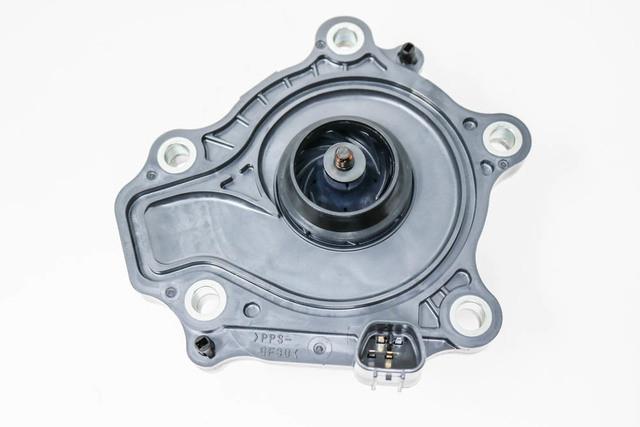
In typical Toyota and Lexus hybrids — Prius from the second generation, Auris, Corolla, Yaris, Camry, RAV4 and the CT, ES, NX, RX and UX — the engine coolant pump is electric. A belt from the crankshaft does not turn it. At the lights and in traffic the petrol engine stops, and the coolant still has to circulate while the head is hot.
Two circuits, two pumps
The tank by the engine radiator is the petrol engine’s circuit. A small reservoir, often with pink fluid, cools the inverter and the electric motors. That is a separate system — the text on inverter coolant describes it. Topping up one does not save the other. The pump this article is about sits by the block and takes power from the 12 V system, not from the traction battery.
How to tell the pump is not working
- The temperature needle climbs in traffic even though the engine keeps stopping
- The vents blow cold, then hot — heat is not leaving the head evenly
- A smell of coolant or damp by the pump and the lower hose
- Once a computer is connected the controller has a pump-circuit fault, often from the P261B family
Stopped in READY, with a warm engine, a sound pump makes a quiet, even hum by the block. Silence with a full tank and a rising temperature is a reason not to drive on.
Why a hybrid overheats in town
The engine works in short bursts and gives off heat in jumps. After it stops, that heat stays in the head. The electric pump is meant to take it to the radiator. When the impeller stops — a worn bearing, a broken supply, air after a coolant loss — the temperature jumps in town, not on a trip, where the airflow cools the radiator anyway.
In a 3rd-generation Prius, an Auris Hybrid and a Lexus CT, overheating ignored for a long time ends in a head gasket. Coolant loss with no puddle under the car is often already the result, not the first cause. We start with whether the pump is pumping at all, and with a leak test of the system.
What shortens the pump’s life
- Old coolant with sediment — the impeller works in dirt and the passages narrow
- Driving with a low level — the pump sucks air and seizes
- A weak 12 V system: a corroded earth or a voltage drop at which the controller will not hold the pump
Replacing the water pump is a cooling-system repair. A hybrid message can come later, when the car is already limiting power after overheating.
What not to do at the roadside
Do not open the cap of a hot tank. Do not pour in water “to get home” and do not clear the warning by driving on once the needle was already high. A short trip on a flatbed is cheaper than planning a head job. An engine with no coolant circulation must not be driven, even if it still starts for a moment.
Temperature rising in traffic? We will check the pump and the seals before the head is disturbed.
Visit Green Serwis in Krakow — we specialise in Toyota and Lexus hybrids.
Book a visitSummary
In a hybrid the engine coolant does not wait for the crankshaft to turn. An electric pump, separate from the inverter circuit, pushes it. When that pump goes quiet, town heats the head faster than a trip does. That is not a symptom of a weak HV battery. First the coolant level, the pump’s hum and the circuit fault, and only then a search for high-voltage faults. The battery offer is on the page for hybrid service.
